

The Russo-Ukrainian war is an environmental war, for at least the following reasons.
1. It is an environmental war because environmental destruction is a side effect of all wars.1
2. It is an environmental war because environments have been targeted by Russian forces—because disabling Ukraine’s economic potentials, including its agricultural fields, its ability to provide food for itself and the world, as well as its urban environments and industrial infrastructure, is a large part of the goals of the war.2
3. It is an environmental war because ecocide is the logical accompaniment to ethnocide or genocide,3 and the war is ethnocidal by the Russian government’s own admissions.4
4. It is an environmental war because the causes of the war are primarily environmental, or at least ecopolitical and geostrategic. Russia is a petro-state whose economy depends, to an extent greater than with any major economy in the world, on the revenues from its oil and gas reserves.5 This means that as oil and gas become less valuable—as they will with the world’s energy transition toward non-carbon-emitting energy sources—so will Russia’s economy decline.
This accounts for Russia’s leading role (alongside the Arab oil producing countries and the Trump administration) in the international campaign to prevent concerted climate action on phasing out fossil fuels.6 It also makes the shoring up of Russian imperialism all the more strategically important. For historical as well as sentimental reasons, Russian imperial nationalists (including Putin) see Ukraine as central within that project.7 And in case the word “imperial” needs explanation here, it is helpful to recall that of all the European colonial empires that ruled much of the world directly one or two hundred years ago, Russia is the last one still standing, still unreconstructed by anti-colonial movements.8
5. It is an environmental war because Ukrainians’ defense of their territory is rooted, to a degree greater than it would be in many places, in an understanding that Ukrainians and the land they live on—their zemlia—make for a deeply valued partnership. It is not that Ukrainians haven’t been displaced from that land by industrialization, mechanization of agriculture, and rural to urban migration, all of which the Soviet state ramped up to an intense degree, telescoping processes that took a few centuries in Britain, France, and elsewhere into the space of a century. The ways in which serfdom and other ethnopolitical-ecological relations imposed by the Russian empire, or by Polish rule, substantiated a certain relationship between Ukrainians and land is part of that equation. The legacy of Ukrainian connections to the land, a legacy retained and celebrated in poetry, music, and other forms of popular culture, is one that still retains a vibrancy at times when land is clearly under attack.9
6. To summarize the above, it is an environmental war in the same way that wars have always been environmental. This is a lesson of environmental history: wars have, for centuries, been fought between people defending land and their relationships with it from those who would like to replace those relationships with others that favor their own kind, that see their land as suitable for expansion, or extraction, or some other end. And while that process has gone on for millennia, there is an intensity and global reach to these expansionist wars in the last five centuries or so that has been undeniable—an expansion over and against those people and places that are “in the way.”
Ukrainians and the Ukrainian land are “in the way” of Russia’s neo-imperialist plans. (As they were during the Stalin-produced Holodomor of the early 1930s.) This is analogous to the ways in which Indigenous peoples and their lands were “in the way” of European colonization, for centuries; and the way in which Palestinians are “in the way” of the Netanyahu regime’s plan for a Greater Israel; and… add your own examples, of which there are many.
And in a world of multipolar imperialisms, the only ethically defensible position is to extend solidarity to every victim resisting every and any imperialism. The opposite of imperialism is not some vague and selective rhetorical “anti-imperialism.” It is democratic self-determination that is rooted in one’s place. It is tuteishist’, the defense of what is here, tut, and globally it is the solidarity of the earthbound.10
7. Finally, the Russo-Ukrainian war is environmental in the way that future wars will all be environmental, in a world affected by climate disruptions, rising sea levels, intensifying weather disasters, and the demographic shifts, agricultural failures, economic hardships, and resource and land conflicts that will accompany these. The climate-destabilized world to come is the culmination of centuries of imperialist, extractivist, and colonial-capitalist “resourcifying.”11
The lessons from Ukrainians’ resistance are thus lessons all of us (hopeful survivors) will need to learn. The sooner we recognize our shared precarity in the face of climate change, the sooner we will see the outlines of the “ecological class struggle” to come: a struggle of the “global climate precariat” against the “fossil-fuel protectorate” and its technopolitical allies, for whom the struggle to dominate is paramount, with all social and ecological costs offloaded onto others (or onto the future).
Communicating this shared condition of climate precarity is therefore of great importance, and it is a task for artists and media makers as much as for anyone else. That’s why Terra Invicta, the book from which the above argument comes, puts such a strong emphasis on images and the work of artists. (That, of course, is consistent with my other work, such as The New Lives of Images.)
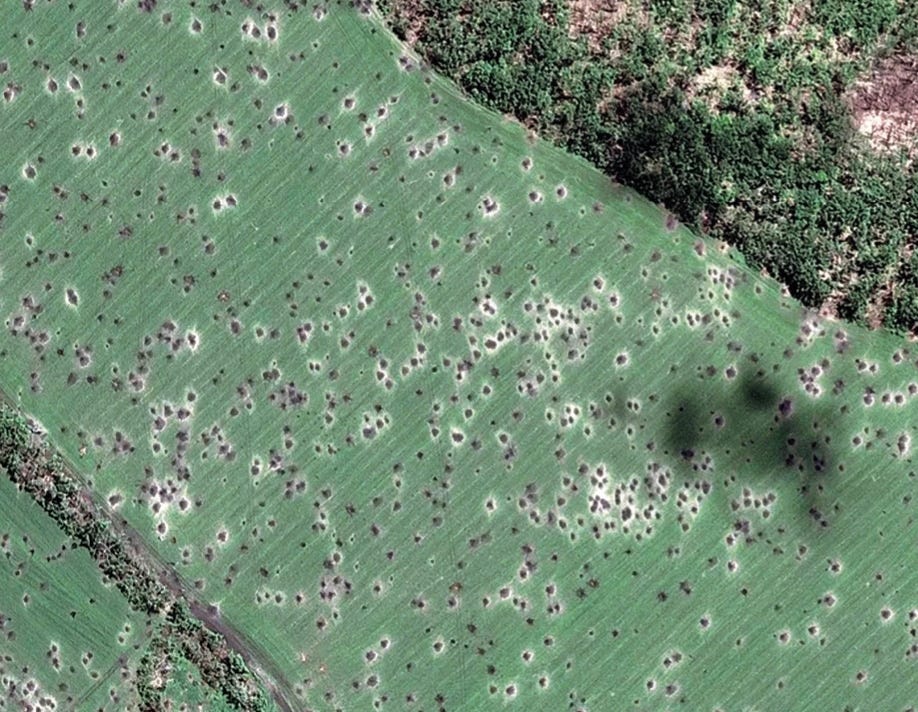
(To see the images Terra Invicta works with—in effect, counter-images to the destruction of the landscape portrayed in the satellite picture below—you’ll have to get the book. It is available from McGill-Queen’s University Press. But it is also open-access, available for free to all. It is a book that Slavoj Žižek says “deserves to become an instant classic, a volume that everyone who wants to grasp the contours of our global crisis should read.” See also Marin Coudreau’s wonderfully detailed review of it from the French radical ecology journal Terrestres. entitled “Terre invaincue: la catastrophe écologique à la lumière de l’Ukraine en guerre.”)
See Jay E. Austin and Carl E. Bruch, eds., The Environmental Consequences of War: Legal, Economic, and Scientific Perspectives (Cambridge University Press, 2000); Lisa M. Brady, War and the Environment in the Modern World: A Global Perspective (Bloomsbury, 2017); Jurgen Brauer, War and Nature: The Environmental Consequences of War in a Globalized World (Bloomsbury Academic, 2011).
Darya Tsymbalyuk, Ecocide in Ukraine: The Environmental Cost of Russia’s War (Polity, 2025); Daniel Hryhorczuk, Barry S. Levy, et al., “The Environmental Health Impacts of Russia’s War on Ukraine,” Journal of Occupational Medicine and Toxicology 19.1 (2024), doi.org/10.1186/s12995-023-00398-y; Ukraine War Environmental Consequences Work Group, https://uwecworkgroup.info
Damien Short and Martin Crook, eds., The Genocide-Ecocide Nexus (Routledge, 2022).
See Vladimir Putin, On the Historical Unity of Russians and Ukrainians; Clara Apt and Viola Gienger, “Russia’s Eliminationist Rhetoric Against Ukraine: A Collection,” Just Security, 20 Oct 2025, https://www.justsecurity.org/81789/russias-eliminationist-rhetoric-against-ukraine-a-collection/.
See Alexander Etkind, Russia Against Modernity (London: Polity, 2023); Thane Gustafsson, Klimat: Russia in the Age of Climate Change (Harvard University Press, 2021); Margarita M. Balmaceda, Russian Energy Chains: The Remaking of Technopolitics from Siberia to Ukraine to the European Union (New York: Columbia University Press, 2021); Oxana Timofeeva, “Oil Curse: Russia’s Petroimperialism and the (In)Human Geographies of War,” Mediapart, 1 Nov 2022, https://blogs.mediapart.fr/berliner-gazette/blog/011122/oil-curse-russia-s-petroimperialism-and-inhuman-geographies-war; Ariel Cohen, “Russia’s Oily and Gassy Crony Capitalism: The Path To Kleptocracy,” Forbes, 31 May 2019.
Jordi Roca Jusmet, “COP30: Petrostates block climate deal once again, but some countries are taking their own decisive steps to phase out fossil fuels,” The Conversation, Nov 26 2025, https://theconversation.com/cop30-petrostates-block-climate-deal-once-again-but-some-countries-are-taking-their-own-decisive-steps-to-phase-out-fossil-fuels-270580.
Kuzio, Taras. “Imperial Nationalism as the Driver Behind Russia’s Invasion of Ukraine,” Nations and Nationalism 29, no. 1 (2023), 30–8.
On Russian colonization of the Siberian Far East, see James Forsyth, A History of the Peoples of Siberia (Cambridge University Press, 1994); John J. Stephan, The Russian Far East (Stanford University Press, 1994); Alan Wood, Russia’s Frozen Frontier (Bloomsbury Academic, 2011). On Russian imperial coloniality more generally, see Morrison, “Russian Settler Colonialism,” in The Russian Handbook of Settler Colonialism, ed. E. Kavanagh and L. Veracini (Routledge, 2017), 313–326; Etkind, Internal Colonization: Russia’s Imperial Experience (Polity, 2011); Etkind, “How Russia ‘Colonized Itself’,” International Journal for History, Culture and Modernity 3.2 (2015), 159-172. On Russia as a Janus-faced empire, see Tlostanova, “The Janus-faced Empire Distorting Orientalist Discourses: Gender, Race and Religion in the Russian/(post)Soviet Constructions of the Orient,” Worlds & Knowledges Otherwise: On the Decolonial (II) Gender and Decoloniality 2. 2 (2008). On decolonizing Russia, see Ivakhiv “Decolonization (of the Unnamed Other) is Not a Metaphor,” in Terra Invicta, ed. A. Ivakhiv (McGill-Queen’s University Press, 2025), 335-348.
This is seen in recent exhibitions such as “The Heart of the Earth” (Sertse Zemli) held at Ukraine’s largest art and museum complex, Kyïv’s Mystetskyi Arsenal, in 2022-23, and in an array of popular memes drawing on the famed relationship between Ukrainians and their black soil (chornozem), among many others analyzed in a recent volume I edited. See Ivakhiv, ed., Terra Invicta, especially the chapters by Ostrovska-Liuta, Botanova, Bazdyrieva, and Kovalenko.
Bruno Latour’s concept of the “earthbound” was presented in Down to Earth: Politics in the New Climatic Regime (Polity, 2018) and his later collaborative writings such as Critical Zones and On the Emergence of an Ecological Class: A Memo. See also Daniel Matthews, Earthbound: The Aesthetics of Sovereignty in the Anthropocene (Edinburgh University Press, 2021), the Institute for Earthbound Studies, and my writing on the topic in Terra Invicta and on Immanence.
I take the concept and the term “resourcification” from my Master’s mentor, the late John Livingston. It’s a term I used in my doctoral dissertation and first book, Claiming Sacred Ground. It’s been astutely applied to the Ukrainian context by Asia Bazdyrieva; see her chapter in Terra Invicta.
Marvelous… Thanks. 🙏🏼 Looking forward to reading this.